
Why I built a /friends page: making room for other people
/ 7 min read
Table of Contents
A personal website slowly becomes a record of what you pay attention to.
Mine has a build log for things I make, a reading list for books I spend time with, bookmarks for things I want to return to, and a blog for thoughts that need more room. Put those pages together and you get a reasonable picture of my interests.
The people around those interests deserve a place here too. Friends building something, colleagues doing work I admire, people making their own small corner of the internet more interesting. I wanted a page where I could introduce them.
So I built /friends.
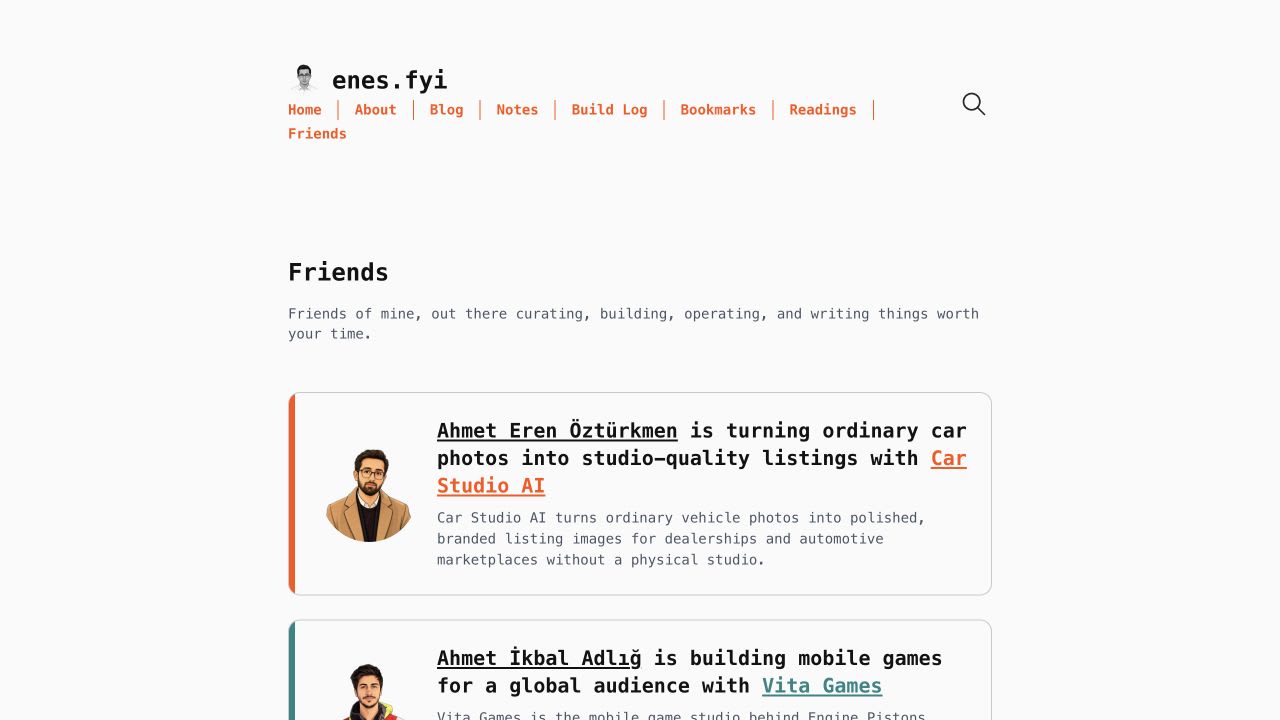
My /friends page: a face, a sentence about what someone does, and somewhere to go next.
A personal website has room for other people
There is a familiar route through a personal site. Read about the owner, look at their work, browse their writing, find a way to follow them. Each page adds another piece to the same person’s story.
That makes sense. We build these sites to collect things that would otherwise be scattered across platforms. But the story gets more complete when other people appear in it.
A project can be associated with one person’s name while carrying the influence of several others. Someone helped shape the idea. Someone gave useful feedback. Someone made a difficult stretch easier. There are also people whose work simply makes you glad you know them.
I like having a place to point at those people. Giving someone a little room on my site feels like a natural extension of keeping a personal site in the first place.
Nick Gray’s July 2026 essay starts with a similar observation: his website had pages about his life and work, but very little evidence of the friends in it. He made a friends page, then built SlashFriends so people could find other pages using the same address.
His own version is wonderfully simple. A heading, an introduction, a list of names. Further down, there are small details about people and how they crossed paths. The format leaves plenty of room for the person writing it.
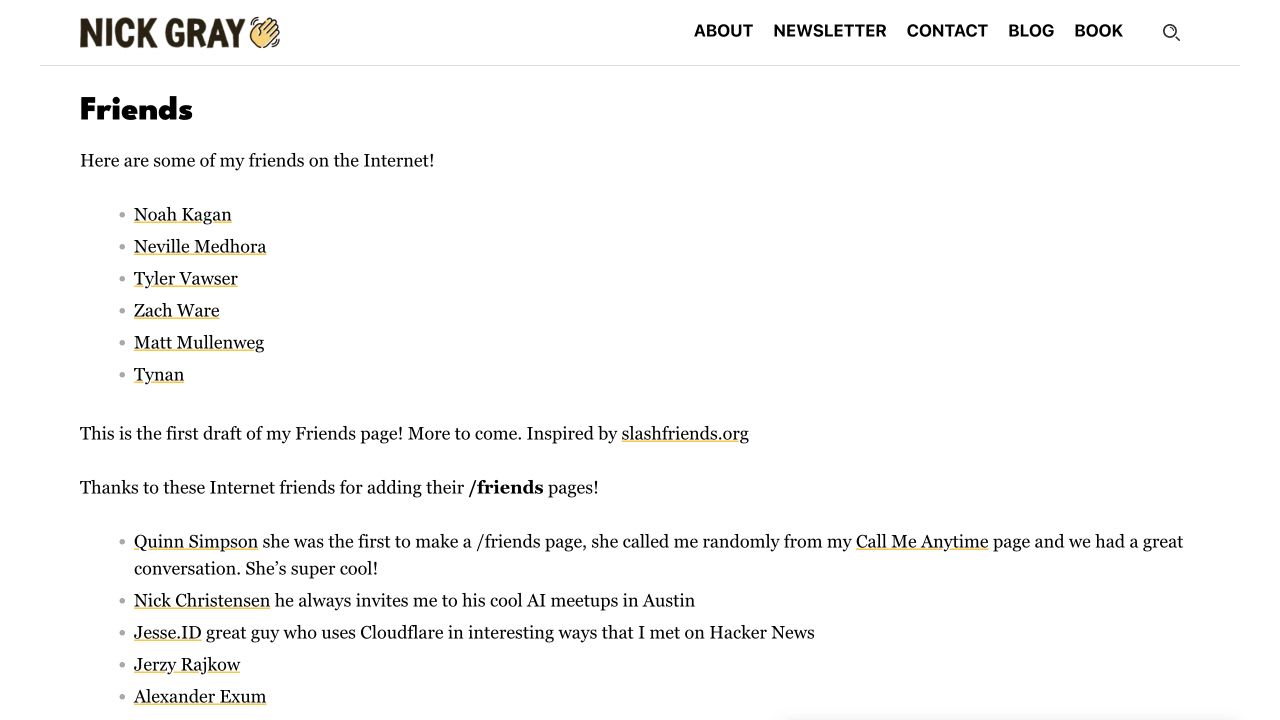
Nick Gray’s page. The first version can be as simple as a few links.
An old habit with a useful address
The behaviour has a long history. A blogroll is a list of sites someone reads or recommends. Personal websites have been making introductions this way for years.
The current /friends convention gives that habit a predictable address. Once you have seen a few of these pages, you know where to look on someone else’s site. The SlashFriends directory helps connect them, but each page still belongs to the person who made it.
I find that combination appealing. A shared convention makes things easier to discover; the contents remain personal. One page might be a short list of close friends. Another might include collaborators, writers, or people the owner has learned from at a distance.
You can follow a link from one person’s site to another person’s site, then keep going. Each stop comes with a small recommendation from the person before it. There is a little context attached to the journey.
The same page can tell different stories
Ryan Doyle’s page opens with a sentence I liked:
Building on the internet looks solo from the outside. It isn’t.
His introductions explain the part each person has played: a business partner, someone who showed him what was possible, people he has learned from. Together, they reveal some of the relationships behind his work.
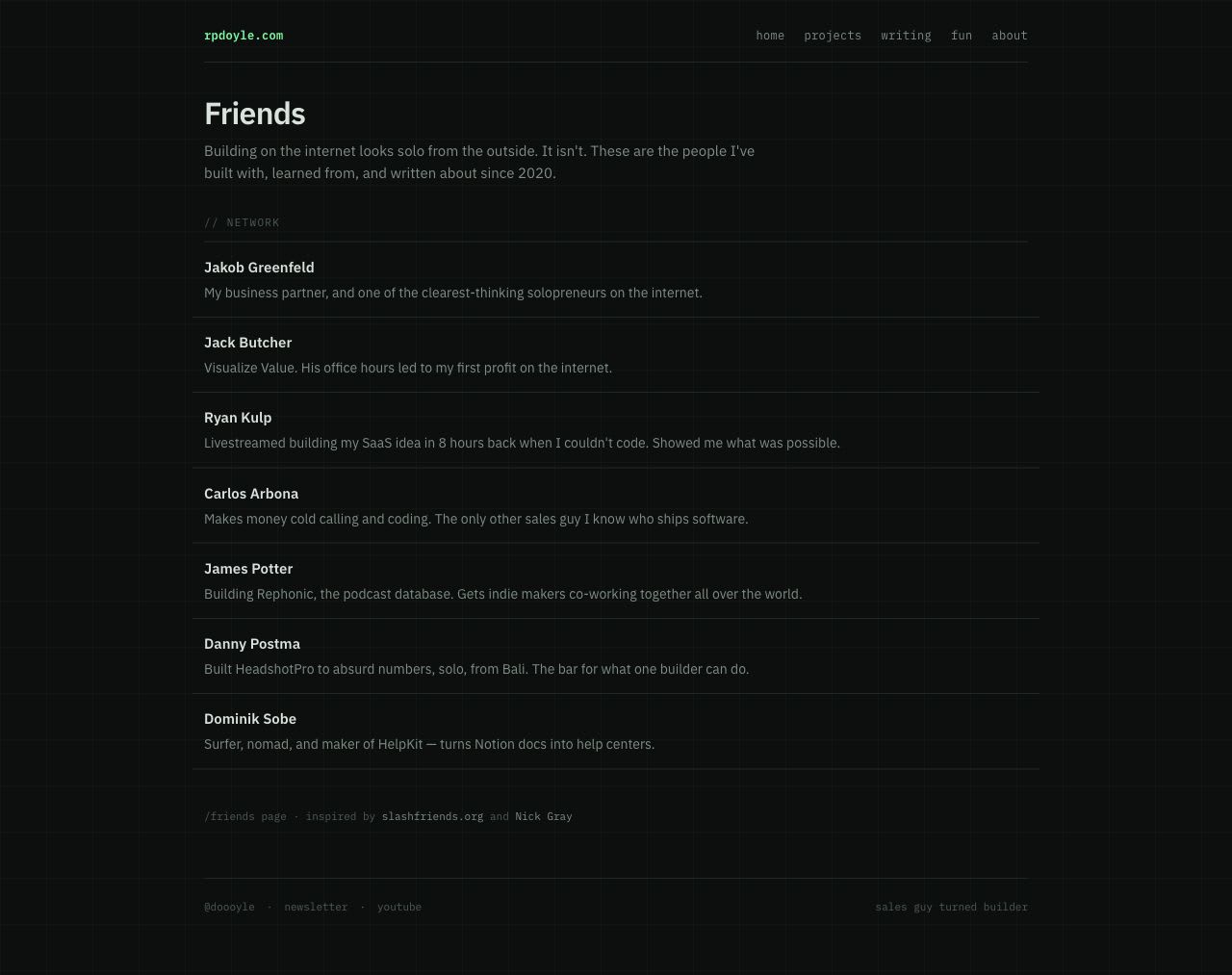
Ryan Doyle’s page gives each name a little history.
Farhan Srambiyan uses three sections: friends, people who inspire him, and people he admires. Some are people he knows; others have influenced him through their work. The headings make those relationships easy to understand.
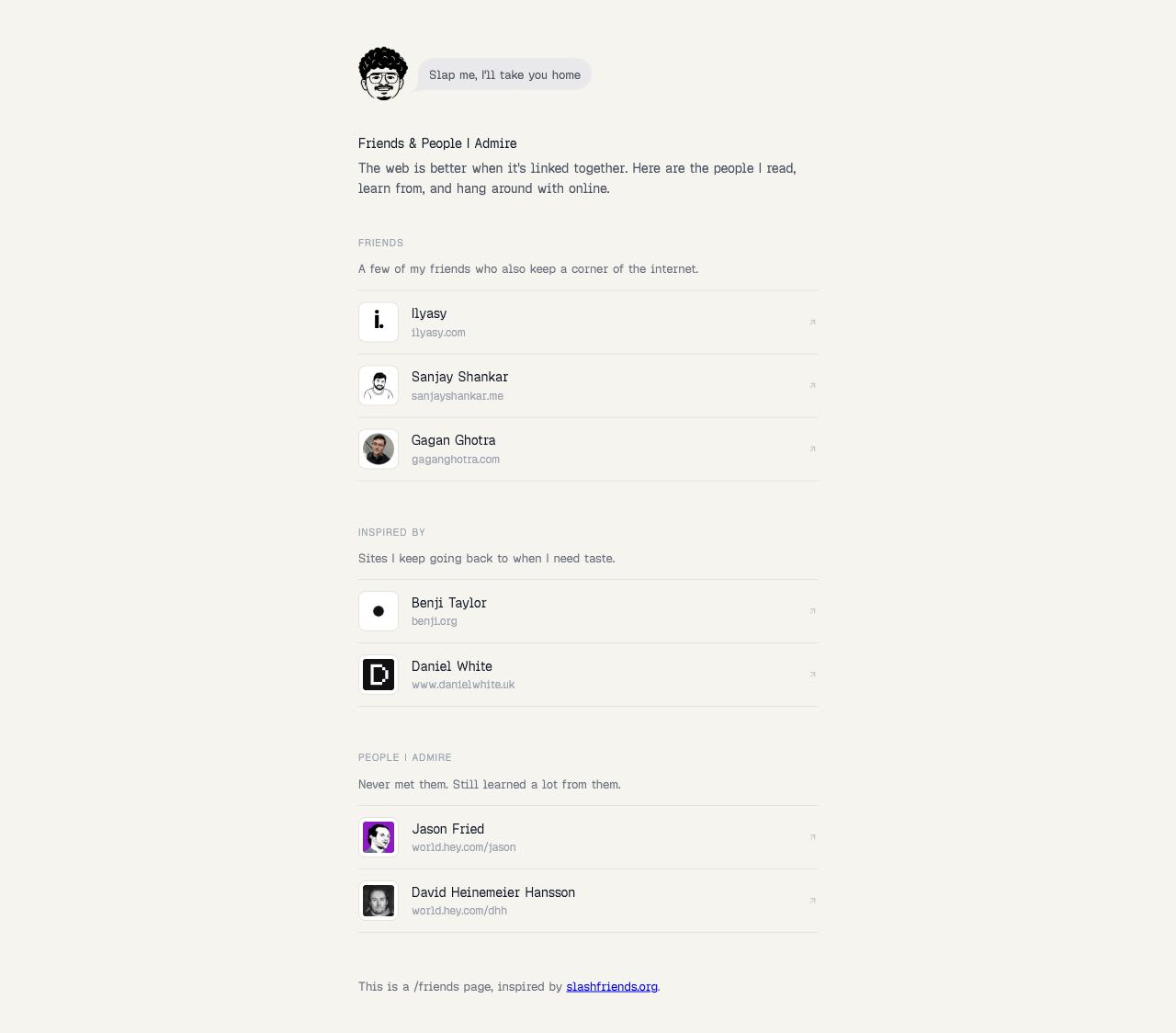
Farhan’s page makes space for several kinds of connection.
These pages helped me think about what I wanted mine to say. The address is shared, but the meaning comes from the introductions. A few words can explain why this particular person belongs in your corner of the web.
Give someone a reason to click
A name and a URL are enough to make a link. One more sentence can make it an introduction.
If I send you someone’s profile, you can work out who they are. If I also tell you what they are making, writing, or exploring, you have a reason to be curious before you arrive.
That is the part I wanted to spend time on. I like recommendations that carry some of the recommender’s attention with them. Something about this person caught their interest, and they took a moment to explain it.
There is a different kind of trust in a page like that. You can see who chose the links. You can read their explanation. Over time, you learn whether their interests overlap with yours.
A friends page gives that kind of recommendation a home. It can sit there quietly, waiting for the reader who happens to be interested in the same thing.
How I made mine
On my page, each entry has a face, a sentence about what the person is doing, and a little context about the work or project. There are links to the person and, where available, to the thing they are working on.
The sentence follows a simple shape: someone is doing something, with or at somewhere. It pushes me to describe an activity rather than stop at a job title.
There is quite a range. Merya İlvan brings builders and founders together through Third Room. Yekta Pektaş is building Lecta, a city guide around places people recommend. Yeşim Özsöz works on making AI useful for teachers and students with Madlen. Elsewhere on the page there are people working in games, research, operations, storytelling, and finance.
That variety is part of what I enjoy about the list. A personal website can show the overlap between worlds that usually live in separate tabs.
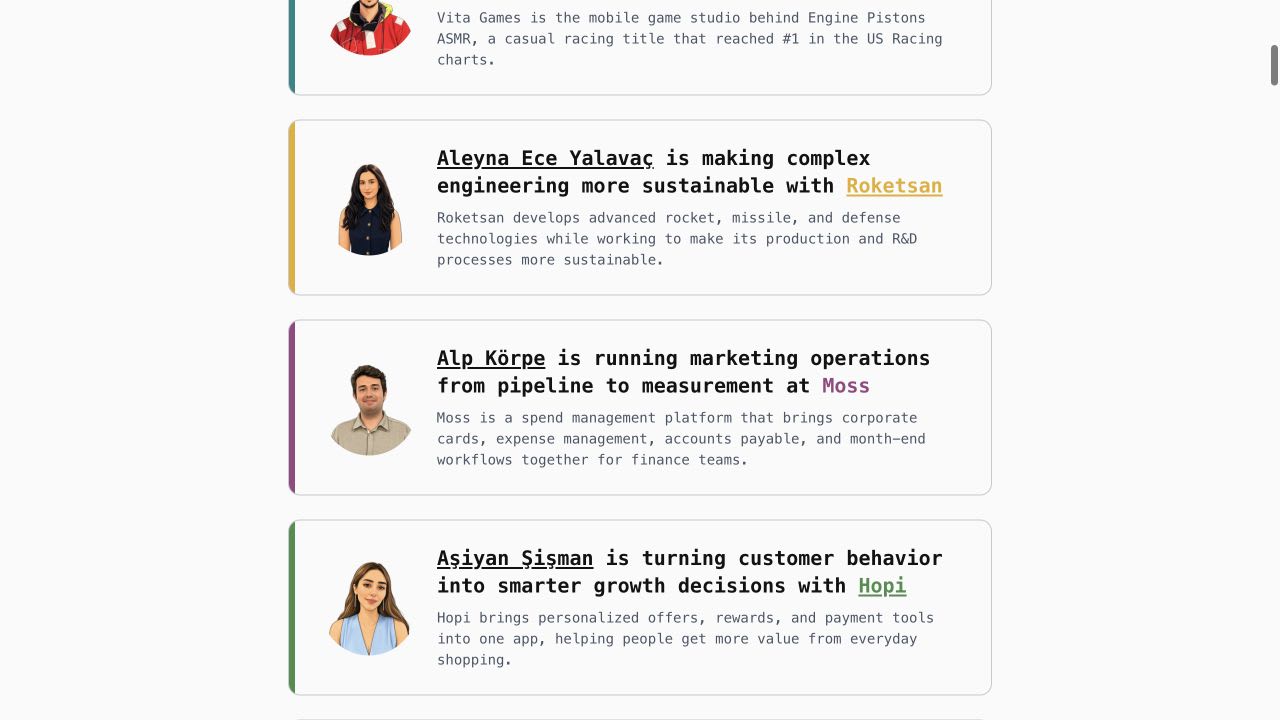
More of /friends. The short descriptions give a little context before you follow a link.
I used alphabetical order because it gives the page an easy shape. A personal site or a public profile both work as destinations. The useful thing is that the reader can find the person, then decide what to explore.
The descriptions will need to change as people’s work changes. That feels right for a page about people. It gives me a reason to return, notice what they are doing, and keep the introductions useful.
A small page that points somewhere
I don’t expect every visitor to browse the whole list. Someone might recognise a name, follow one project, or discover a person whose work fits a question they have been thinking about.
That is enough for me. The page has done something useful if it makes one good introduction.
A lot of the internet is built around getting attention and keeping it. I like having a page whose purpose is to pass some of that attention along. It makes this site feel a little closer to the life around it.
You can start with a handful of names and write why you want someone else to know them. The work is mostly in paying attention, then putting that attention into a sentence.
My version is at /friends. Take a look. There may be someone there you would be glad to know.